

5 Saltwater Aquarium Mistakes Beginners Should Avoid
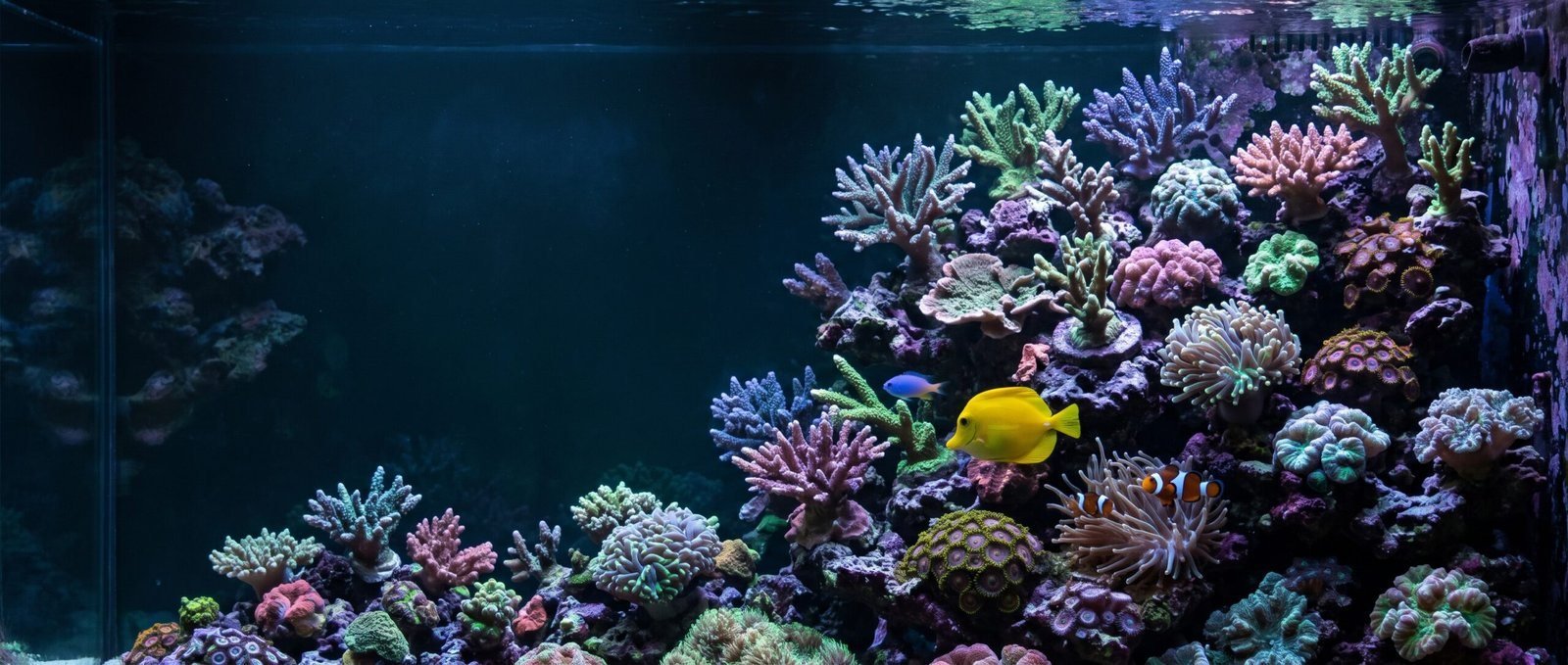
Building your first saltwater aquarium? Learn five common reef tank mistakes, why they happen, and how to avoid them before they cost you time, money, or livestock.
A thriving saltwater aquarium can be one of the most rewarding displays in your home. Colorful marine fish, fascinating invertebrates, and living corals create an underwater ecosystem that changes and grows over time.
But a beautiful reef tank doesn’t happen simply because you purchase the right equipment.
Many beginner saltwater aquarium mistakes come from doing too much, too quickly: adding livestock before the biological filter is ready, buying more clean-up crew animals than the aquarium can feed, or constantly adjusting water chemistry to chase perfect numbers.
The good news? Most of these mistakes are preventable.
Here are five important lessons that will help you build a healthier, more stable saltwater aquarium.
1. Buying More Clean-Up Crew Animals Doesn’t Mean a Cleaner Tank
One of the first recommendations new saltwater hobbyists encounter is to purchase a clean-up crew.
A clean-up crew, often called a CUC, consists of invertebrates that help consume algae, leftover food, and other organic material.
But not every clean-up crew animal performs the same job.
And adding too many can create problems of its own.
Different animals have different jobs
Consider these common saltwater aquarium invertebrates:
| Animal | Primary role | Important consideration |
|---|---|---|
| Trochus snails | Graze algae on glass and rock | Need enough suitable algae to eat |
| Cerith snails | Graze films and organic material on surfaces | Activity and diet vary by species |
| Nassarius snails | Scavenge meaty food and burrow in sand | Not algae eaters; require appropriate food |
| Cleaner shrimp | Scavenge food and may clean fish | Not a substitute for parasite treatment |
| Hermit crabs | Scavenge and sometimes graze algae | Some may attack snails or disturb corals |
A Nassarius snail, for example, cannot replace an algae-grazing snail because it performs a different ecological role.
Likewise, a shrimp will not solve a persistent hair algae outbreak simply because it is sold as part of a clean-up crew.
Why overstocking your clean-up crew is risky
A newly established reef aquarium may have very little natural food available.
If you add a large number of grazing snails before algae becomes established, some may struggle to find enough food.
The same problem can occur after a temporary algae bloom disappears.
Rather than purchasing a fixed number of snails for every gallon, choose animals based on the aquarium’s actual needs.
What beginners should do:
- Complete the aquarium’s nitrogen cycle before adding clean-up crew animals.
- Identify whether your problem is algae, leftover food, or accumulated detritus.
- Select species suited to that specific task.
- Begin with a modest number of animals.
- Observe their feeding activity and add more only when the aquarium can support them.
The takeaway: Your clean-up crew is a group of living animals with specific dietary needs—not a disposable cleaning product.
2. Clear Water Doesn’t Mean Your Aquarium Is Ready for Fish
One of the most dangerous beginner assumptions is that an aquarium is safe because the water looks clean.
Unfortunately, harmful dissolved substances can be completely invisible.
A newly filled saltwater aquarium may look crystal clear while lacking the beneficial bacteria needed to process fish waste.
Understanding the nitrogen cycle
Fish excrete ammonia, a waste product of metabolism, through their gills. Uneaten food and other decaying organic matter can also release ammonia as they break down.
In an established aquarium, beneficial microorganisms process this waste through a biological cycle:
Ammonia → Nitrite → Nitrate
Ammonia is particularly dangerous in saltwater because its toxicity depends partly on pH and temperature.
The biological filtration system must develop enough capacity to process the waste produced by the animals you intend to keep.
This process is commonly called cycling the aquarium.
How do you know when your saltwater tank is cycled?
Don’t rely on how many days the aquarium has been running.
Instead, use a reliable marine aquarium test kit and follow a recognized cycling method.
Before introducing fish or invertebrates:
- Confirm the biological filter can process the ammonia load used during cycling.
- Check that ammonia and nitrite are no longer accumulating.
- Verify temperature and salinity are appropriate and stable.
- Make sure pumps, filtration, and heating equipment are functioning correctly.
- Introduce livestock gradually rather than all at once.
A zero-ammonia reading alone does not prove that an unused, newly filled aquarium has an established biological filter.
The takeaway: An aquarium becomes biologically ready through a functioning nitrogen cycle—not simply through the passage of time.
3. Constantly Adjusting Water Parameters Can Be Worse Than Small Imperfections
Saltwater aquariums require attention to water chemistry.
However, beginners sometimes become so focused on achieving ideal numbers that they repeatedly adjust their water.
This can create instability.
Which water parameters matter?
For a typical tropical marine aquarium, important parameters include:
| Parameter | Why it matters |
|---|---|
| Salinity | Controls the concentration of dissolved salts |
| Temperature | Influences animal metabolism and oxygen availability |
| Ammonia | Indicates potentially dangerous waste accumulation |
| Nitrite | Helps assess biological filtration during cycling |
| Nitrate | A nutrient that requires monitoring and management |
| Phosphate | A nutrient relevant to algae and coral health |
| Alkalinity | Helps buffer pH and supports coral calcification |
| Calcium and magnesium | Important for calcifying organisms |
Not every aquarium needs the same testing schedule.
A fish-only aquarium has different demands from a reef aquarium containing rapidly growing stony corals.
Why stability matters
Imagine that your aquarium’s alkalinity test gives a slightly different reading than yesterday.
Immediately adding supplements without confirming the result may cause a larger fluctuation than the original difference.
Instead, check the test procedure, consider normal measurement variation, and look for a consistent trend.
When a parameter is genuinely unsafe, prompt corrective action may be necessary. Stability should never be used as an excuse to ignore toxic ammonia, dangerous temperatures, or major salinity problems.
What beginners should do:
- Test consistently with appropriate marine test kits.
- Record results to identify trends.
- Check questionable readings before making chemical adjustments.
- Match replacement saltwater to the aquarium’s salinity and temperature. Use the Water Parameter Calculator to convert salinity units.
- Replace evaporated water with appropriate fresh purified water—not saltwater.
- Avoid dosing calcium, alkalinity, or other supplements without a demonstrated need.
The takeaway: Aim for suitable, stable water conditions instead of constantly chasing a perfect number.
4. Algae Doesn’t Automatically Mean Your Reef Tank Is Failing
A patch of brown film on the sand or green algae on the glass can be alarming when you’re new to reefkeeping.
But algae growth is not automatically evidence of a failed aquarium.
Many new systems experience changes in microbial and algal communities as the tank develops.
Diatoms and other films may appear on surfaces during early stages.
The important question is not simply whether algae exists.
It’s what kind of growth you’re seeing, why it’s appearing, and whether it is becoming harmful.
Common causes of unwanted algae growth
Algae problems may involve several interacting factors:
- Excess food entering the system
- Nutrient accumulation
- Lighting intensity or duration
- Inadequate export of accumulated waste
- Insufficient grazing for the type of algae present
- Changes in the aquarium’s developing ecosystem
Not every brown, green, or red growth is the same organism. Cyanobacteria and dinoflagellates, for example, require different considerations from ordinary green film algae.
Should you remove all nitrate and phosphate?
No.
Nitrate and phosphate are nutrients used by organisms in reef ecosystems, including corals and their symbiotic algae.
The goal is not automatically to force both nutrients to undetectable levels.
Instead, maintain appropriate concentrations for the livestock you keep and investigate significant changes.
A better approach to algae problems
- Identify the growth as accurately as possible.
- Test relevant water parameters.
- Review feeding, lighting, filtration, and maintenance.
- Remove manageable algae growth manually when appropriate.
- Consider compatible grazing animals only when they can be properly housed and fed.
- Monitor the aquarium before introducing additional treatments.
Avoid purchasing an unfamiliar fish, crab, or sea slug solely because someone claims it will eliminate algae.
Some specialized algae eaters require mature systems, specific diets, or substantially larger aquariums than beginners own.
The takeaway: Algae is a reason to investigate your aquarium’s conditions—not a reason to panic or buy more livestock immediately.
5. Adding Fish Slowly Is More Important Than Filling the Aquarium Quickly
Once your saltwater aquarium has completed its nitrogen cycle, it’s tempting to add every fish on your wish list.
Resist that temptation.
A reef aquarium is a limited environment, and each new animal changes its biological and social balance.
Why adding too many fish causes problems
Introducing several fish at once can increase waste production faster than the biological filter can handle.
It can also create competition for hiding spaces, feeding opportunities, and territory.
Two fish that appear peaceful in a store may behave differently in a smaller home aquarium.
And fish that look small when purchased may grow much larger.
Plan the final stocking list before buying your first fish
Before choosing marine fish, research:
- Adult size: How large will the species become?
- Aquarium requirements: Does the tank provide enough swimming room, shelter, and suitable habitat?
- Temperament: Is the fish territorial or aggressive toward similar species?
- Diet: Can you reliably provide the foods it needs?
- Reef compatibility: Is the species likely to nip corals, consume ornamental invertebrates, or disturb the aquascape?
- Disease prevention: What quarantine, observation, and introduction procedures will you follow?
Reef-safe classifications are useful starting points, but they are not guarantees of individual behavior.
A practical stocking approach
Create a list of the fish you eventually want to keep before purchasing the first one.
Check compatibility among all planned species with the Fish Compatibility Checker, not just between each fish and the aquarium.
Start with appropriately selected, compatible livestock after the system is biologically ready.
Then monitor feeding, behavior, water quality, and overall health before adding more.
Do not rely on a universal rule such as one inch of fish per gallon. Fish of similar lengths can have very different activity levels, body mass, aggression, and environmental requirements.
The takeaway: A carefully planned aquarium with fewer compatible fish is a better starting point than an overcrowded display.
Your Beginner Saltwater Aquarium Checklist
Before buying your first fish, coral, or clean-up crew animal, make sure you can answer these questions.
- Has my aquarium completed a verified nitrogen cycle?
- Can I reliably measure salinity, temperature, and important water-quality parameters?
- Do I understand how to replace evaporated water and prepare water changes?
- Have I researched the adult size, diet, temperament, and compatibility of my planned fish?
- Does each clean-up crew animal have an appropriate food source?
- Do I have a routine for feeding, testing, cleaning, and observing livestock?
- Have I considered disease prevention and safe livestock introduction?
- Am I prepared to wait when the aquarium is not ready for another animal?
If you cannot confidently answer a question, treat it as something to learn before making your next livestock purchase.
Final Thoughts: Build a Healthy Reef, Not Just a Beautiful One
Successful saltwater aquariums are built through patience, observation, and an understanding of the animals that live inside them.
The most expensive equipment cannot compensate for incompatible fish, an immature biological filter, or poor maintenance habits.
And buying more livestock is not always the answer to an aquarium problem.
Start with the fundamentals. Learn how your system responds to feeding, maintenance, and new additions. Make changes based on evidence rather than guesswork.
Over time, those habits can help you build a reef aquarium that is both beautiful and better suited to the long-term needs of its inhabitants.
Continue Your Reefkeeping Journey With Fish Fanatix
Whether you’re researching your first marine fish, learning about clean-up crew invertebrates, or planning your next reef aquarium addition, Fish Fanatix encourages informed livestock choices.
Explore our educational reefkeeping resources and research each animal’s care requirements before making a purchase.
A healthier reef begins with better decisions.
Frequently Asked Questions
What is the biggest mistake beginners make with saltwater aquariums?
One of the most consequential mistakes is adding livestock before the aquarium has developed adequate biological filtration. An uncycled tank may accumulate toxic ammonia even when the water looks perfectly clear.
How long should a saltwater tank run before adding fish?
There is no universally safe number of days. The aquarium should first complete a verified nitrogen cycle and demonstrate that its biological filtration can process the expected waste load.
Do I need a clean-up crew in a saltwater aquarium?
Clean-up crew animals can help manage algae and leftover food, but they are not a substitute for routine maintenance. Choose species based on the aquarium’s needs, maturity, compatibility, and available food.
Is algae normal in a new saltwater tank?
Some algae and microbial growth is common as new aquariums develop. However, persistent or unusual growth should be identified and investigated rather than automatically dismissed as a normal phase.
How often should beginners test saltwater aquarium water?
New aquariums generally require more frequent testing, especially during cycling and after livestock additions. Once established, testing frequency depends on the system, livestock, and parameter stability. Test immediately when unusual animal behavior or a water-quality problem is suspected.
Tags
What do you think?
Related Articles

Before You Buy: Planning Your First Saltwater Aquarium.
Plan your first saltwater aquarium around the animals you want to keep. Work through tank size, placement, equipment, and the ongoing cost of care before
Getting Your Saltwater Aquarium Started
Set up your first saltwater aquarium step by step, from gathering equipment and mixing saltwater to testing the system and starting a fishless cycle.
Is Your Saltwater Aquarium Ready for Livestock?
Use your cycling results, temperature and salinity records, and equipment checks to decide when your saltwater aquarium is ready for its first animals.